
Identity, Participation, Engagement:
The Architecture of a Museum Visit
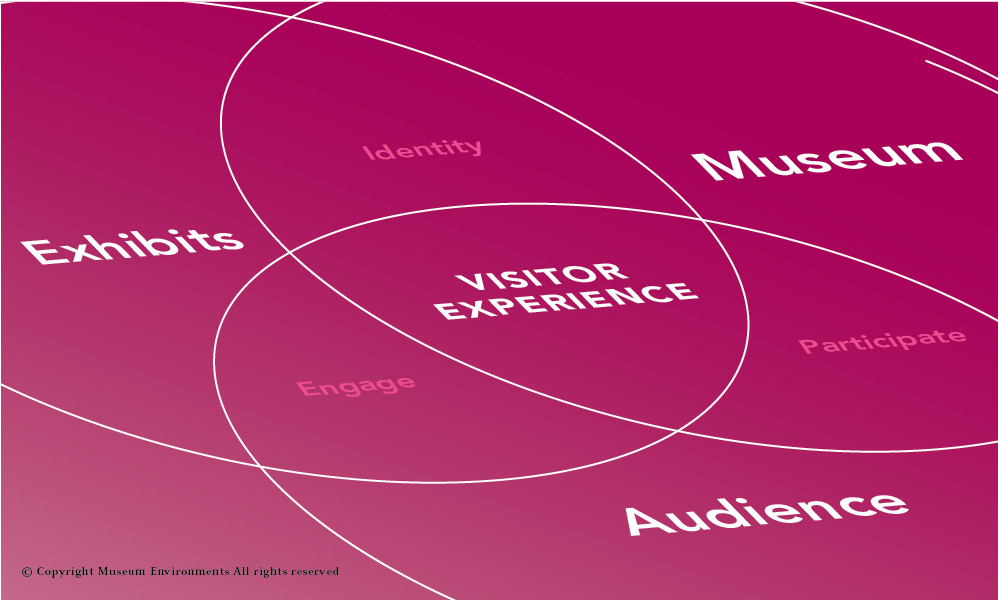
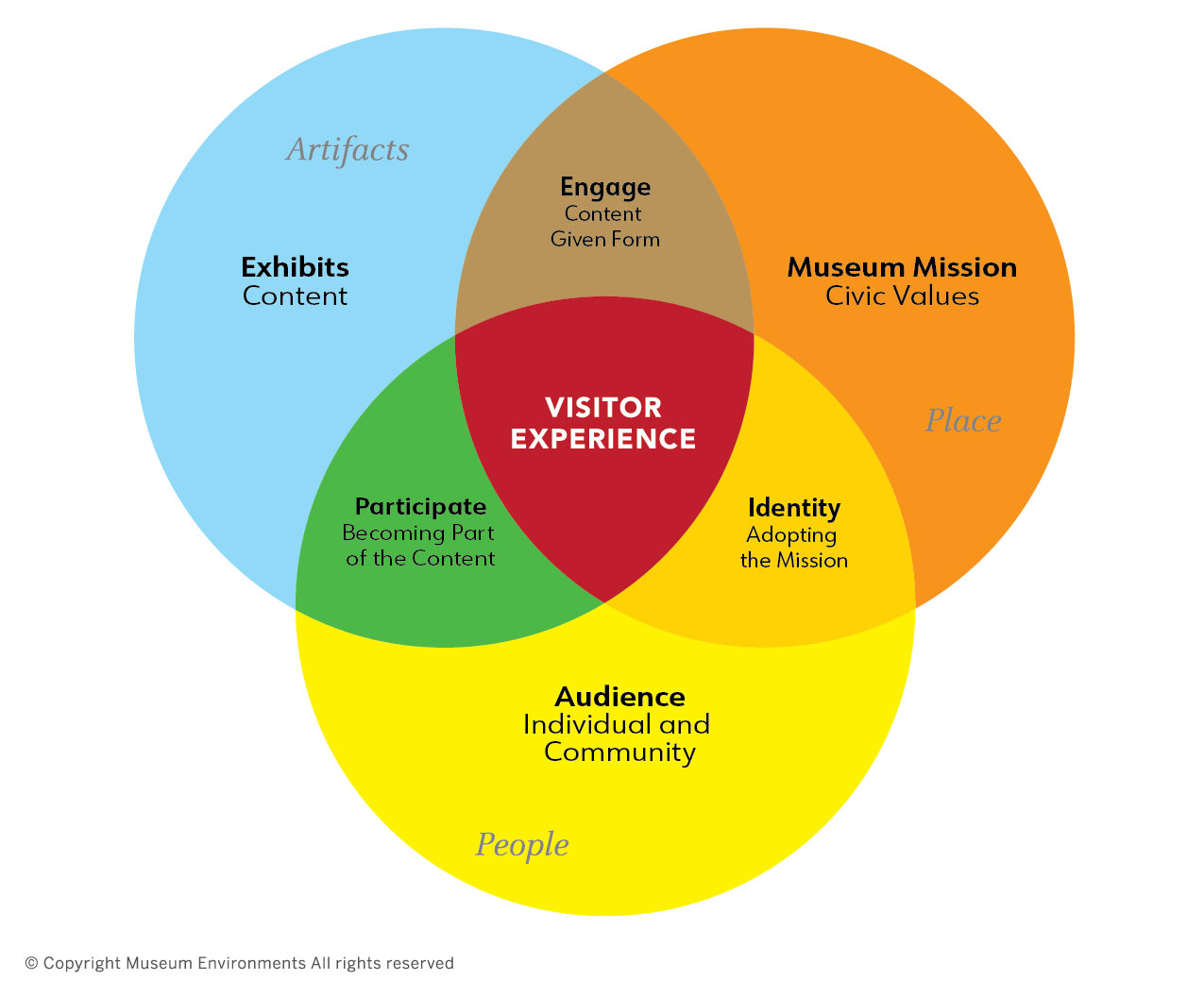
Museum Environments' design practice focuses on the relationship between audience, exhibit content, and institutional mission. By addressing all three simultaneously, we define the interaction between them through three lenses: identity, participation, and engagement. Our goal is for visitors to identify with the civic values of your institution, engage intellectually and emotionally with exhibit content, and participate socially and creatively within the institutional environment. It is in this space — where audience meets institution — that we locate the true benchmarks of value in a museum visit. A successful exhibit design must account for this complete picture to produce a lasting asset for the institution.
Identity
Identifying with the Mission
ME aims to create rich experiences that are unique and unmistakably attached to the institution that created them — because identity isn't decoration, it's the visitor coming to see the museum's mission as their own. Each exhibit is an opportunity to forge that identification. From the audience's perspective, the exhibit must offer clear experiential value to merit a visit. From the institution's perspective, the curator's content, together with the institution's own reputation, creates cultural capital — the value proposition the institution offers the public, in service of its mission. The role of design, then, is to close the distance between what the museum stands for and what the visitor walks away believing about themselves. When that distance closes, the visitor doesn't just learn the mission, they adopt it: they may become explorers, better citizens, creative thinkers, and countless other roles the institution makes available to them. These identities are memorable because the visitor is no longer outside the mission looking in — they're inside it, playing a part only that specific institution could offer them.
Case Study: At the Smithsonian's Molina Family Latino Gallery, the exhibit's identity is inseparable from its mission — to emphatically claim that “Latino history is American history.” Visitors don't just observe that identity; through the exhibit, they come to hold it themselves.
Participation
The Visitor as Subject Matter
Participation is typically framed in terms of interactive elements — buttons to press, screens to touch. At ME, we understand it more broadly: participation happens when the visitor stops observing the subject matter and starts wrestling with it, playing with it, becoming implicated in it. In that sense, the visitor doesn't just act — they become part of what the content is about, a subject in both senses of the word. This can begin from before they even enter the museum, and it continues through the length of their visit. We see at least four measures of value in museum participation: it adds a spatial dimension to the learning experience that aids retention; it creates a temporal experience that provides a moment of resonance and self-reflection; it carries social significance, fostering a relationship between the visitor, the institution, and the broader community; and it can extend beyond the finished exhibit altogether, into the curatorial process itself — inviting the community to help author the museum's story rather than simply receive it.
Case Study: At the El Paso Museum of History, participation began before the exhibit ever opened. Neighborhoods and Shared Memories was community-sourced from the ground up — residents donated objects and oral histories, and local artists co-created murals and ironwork for the exhibit space, making the community itself the curator. That same spirit carries through to the visitor experience, and the exhibit still accepts new community contributions today, so participation never really ends.
Engagement
The Genre of Experience
To absorb, engross, fascinate, interest, intrigue, and charm are all coveted goals for curators and educators alike — but engagement isn't generic. Content takes on a form, much the way a story takes on a genre, and that form determines which facet of the visitor it hooks. Comedy appeals to our sense of silliness and irony. Drama calls on our sense of righteousness. Thrillers draw out our appetite for adventure. Exhibit content works the same way: whether it's shaped as a revelation, a confrontation, a mystery, or a celebration determines which part of the visitor's own character the content reaches. High engagement deepens both the absorption of material and the visitor's relationship with the museum — but only when the form of the content is matched to the part of the visitor it's meant to move. The quality of the information matters, without doubt, but it is the form of its delivery where the experience is actually made. Seeing content as an experience is the job of the exhibit designer, and it requires asking not just what the content is, but what kind of story it wants to be — and which part of the visitor it's reaching for.
Example: The Harlem Gallery of Science's Video Games: The Great Connector doesn't present the gaming industry as a set of facts to learn — it takes the form of an adventure of possibility, hooking visitors' curiosity about their own future rather than their appetite for history.
Copyright © 2026 · All Rights Reserved · Museum Environments
· Log in