
Museum of Chinese in America (NY) Exhibit
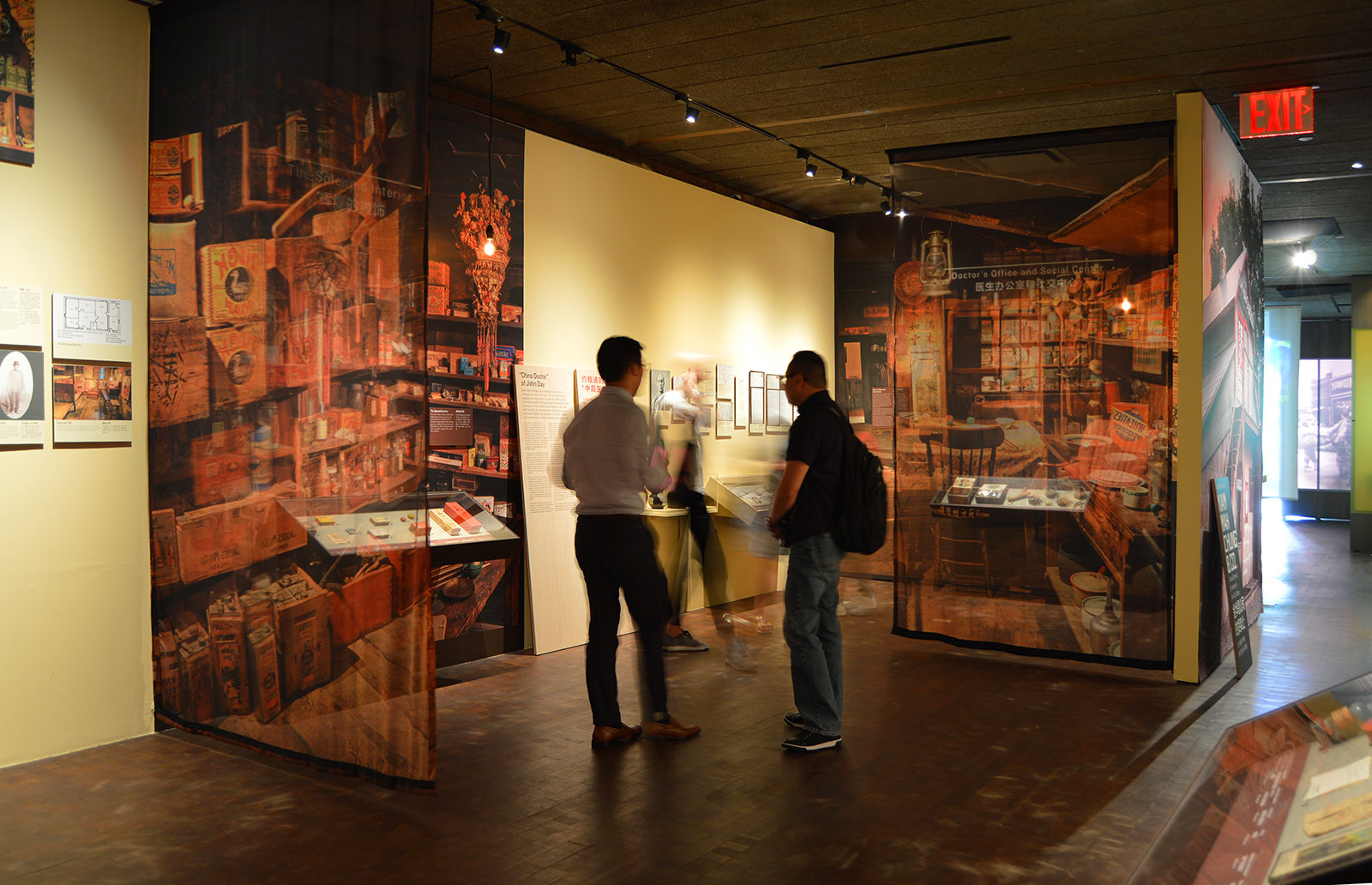
On the Shelves of Kam Wah Chung is an immersive exhibition that celebrates the medical practice of Ing “Doc” Hay who became a prominent figure in eastern Oregon after the California Gold Rush. Practicing out of the Kam Wah Chung & Co. general store in a town called John Day, the exhibition includes Chinese patent medicines developed by the doctor, as well as archival materials such as historical photographs, patient records and correspondences with non-Chinese settlers. In doing so, the exhibition provides an illustration of day-to-day life in the region, and a lesser-known history of Chinese immigration in the Pacific Northwest.
On the Shelves of Kam Wah Chung General Store and Apothecary in John Day, Oregon
April 26, 2018 – September 9, 2018
Client: Museum of Chinese in American (New York)
Curators:
Andrew Rebatta, Associate Curator
Herb Hoi Chum Tam, Curator and director of exhibitions

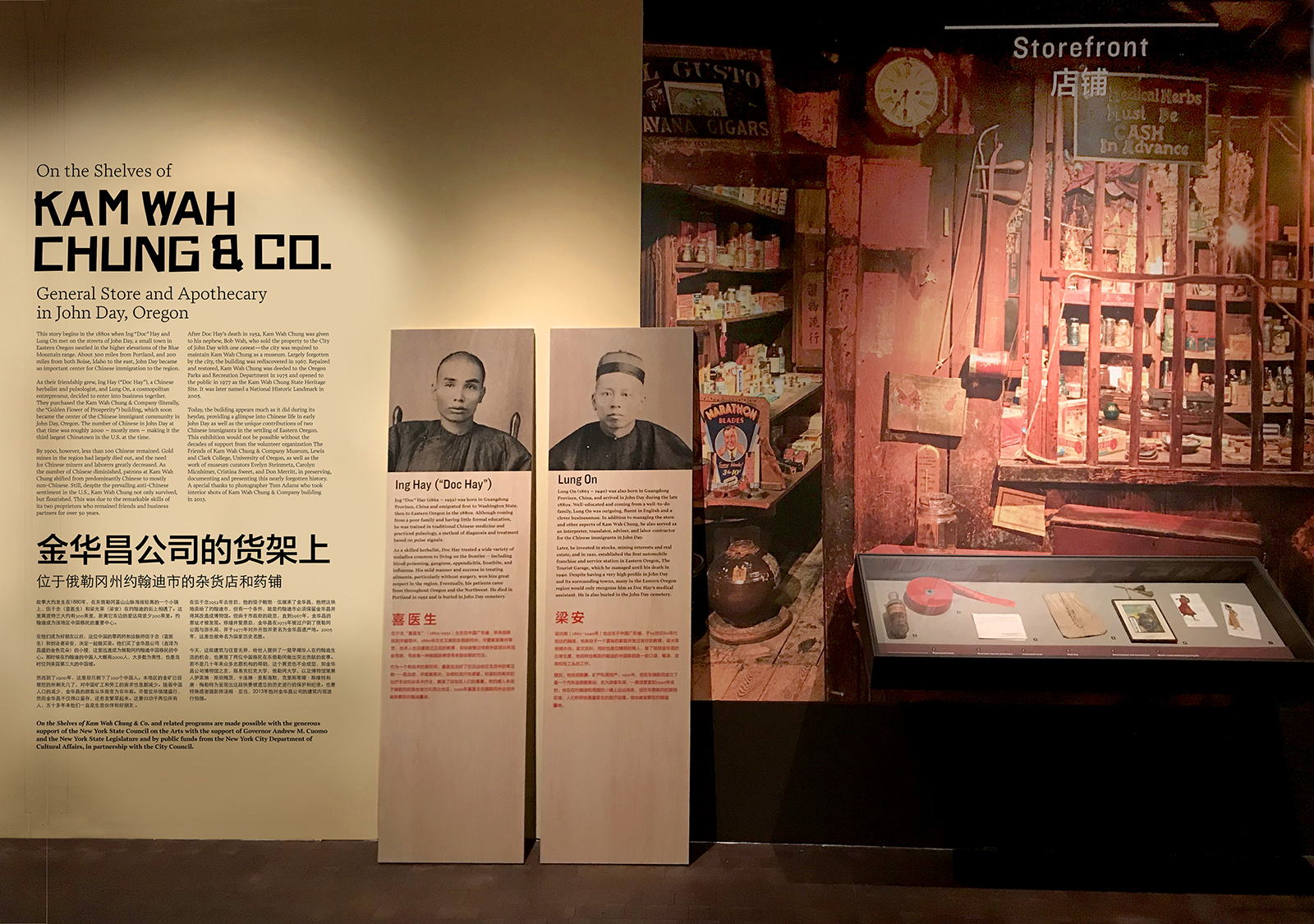
Design Concept: The design produces an immersive environment that recreates the environment of the apothecary in the richness of color, the density of detail, the scale of space, and a quaint sense of sensual luxury. Large-scale reproductions of photographs of the different rooms and shelves of the apothecary are placed on the walls and on translucent curtains. Object cases are placed on top along with graphic panels to add to a layered effect that produces a boundless immersive space. The curators wished to provide the visitor with an experience conveying the rich heritage of Chinese in America.
Design Scope:750 sq. ft.
Re-used existing cases, Graphic murals, printed textile curtains, and direct to medium printed on wood panels.
The exhibit is in English and Chinese (simplified, Mandarin).
On the Shelves of Kam Wah Chung is organized in conjunction with the Kam Wah Chung Heritage Site, which is maintained by the Oregon Parks and Recreation Department.
https://www.nps.gov/places/kam-wah-chung-company-building.htm
Our Services
Museum Environments offers a complete menu of services to help our clients express their vision clearly and powerfully. We have a long history of designing for large institutions such as the Smithsonian, and a breadth of expertise that has allowed us to help diverse smaller institutions complete their projects.
Our core capabilities include:
Exhibit Design: ME designs permanent and temporary exhibits for museums and other cultural institutions. We lead the process from concept to installation.
Interpretive Planning: ME’s content planning process focuses on building visitor experiences that align with the organization’s mission.
Content Development and Coordination: ME provides a content management structure that ensures the final exhibition meets the organization’s curatorial and educational goals. We also coordinate with the registrars to ensure proper installation and protection of artifacts.
Interactive Design: ME designs both digital and physical interactive displays. ME provides the user experience design and outsources the appropriate digital developers to produce effective and affordable solutions.
Print Design: ME designs catalogs and brochures for exhibits. We follow the institution’s branding standards to produce a graphic style that is consistent with its visual heritage and presents an aspirational vision. Our editorial production and publishing expertise allows use to advise clients on the best ways to produce print products while meeting budget targets.
Branding: ME designs logos and comprehensive visual identities for organizations, exhibits and festivals. We build a unique visual language that communicates client values and goals. We deploy that visual identity in print collateral, signage and environmental graphics.
Architectural Coordination: ME has trained architects that can work with architects when needed during installation of exhibits. We have CAD capabilities and we understand architectural drawings.
Museum Experience Planning: Drawing on our expertise in user experience design and institutional branding ME produces a coherent experience for visitors.
Bilingual and Multicultural Assessment: ME reviews your visitor experience with the perspective of multicultural fluency. We evaluate the access to content for non-English speakers and examine how institutional communications translate in multicultural environments.
Design for Mission-Driven Organization

Story-board of entry experience to Walt Disney Family Museum
Planning the Affordable Museum Exhibit: 9 Tips
As curators and exhibit developers you understand well that “you can’t always get what you want.” But if you try… you can often get what you need. When we plan our exhibits, desires always exceed our means. Seeking to help, we offer the following inexpensive ways to design exhibit features. This list of tips is based on years of experience designing exhibits for large and small institutions. They are the ideas that we have found to be the most useful. With a little creativity the solutions you can find are almost unlimited, but these are a good starting point and are easily adapted to specific gallery conditions.
The main criteria we used to select the best tips are how effective they were in improving visitor experience, facilitating installation, and simplifying budgetary decisions. We also assumed you are interested in inexpensive methods of producing exhibits. In all cases there are more sophisticated ways of producing the same item but we focus on doing the most with limited resources.
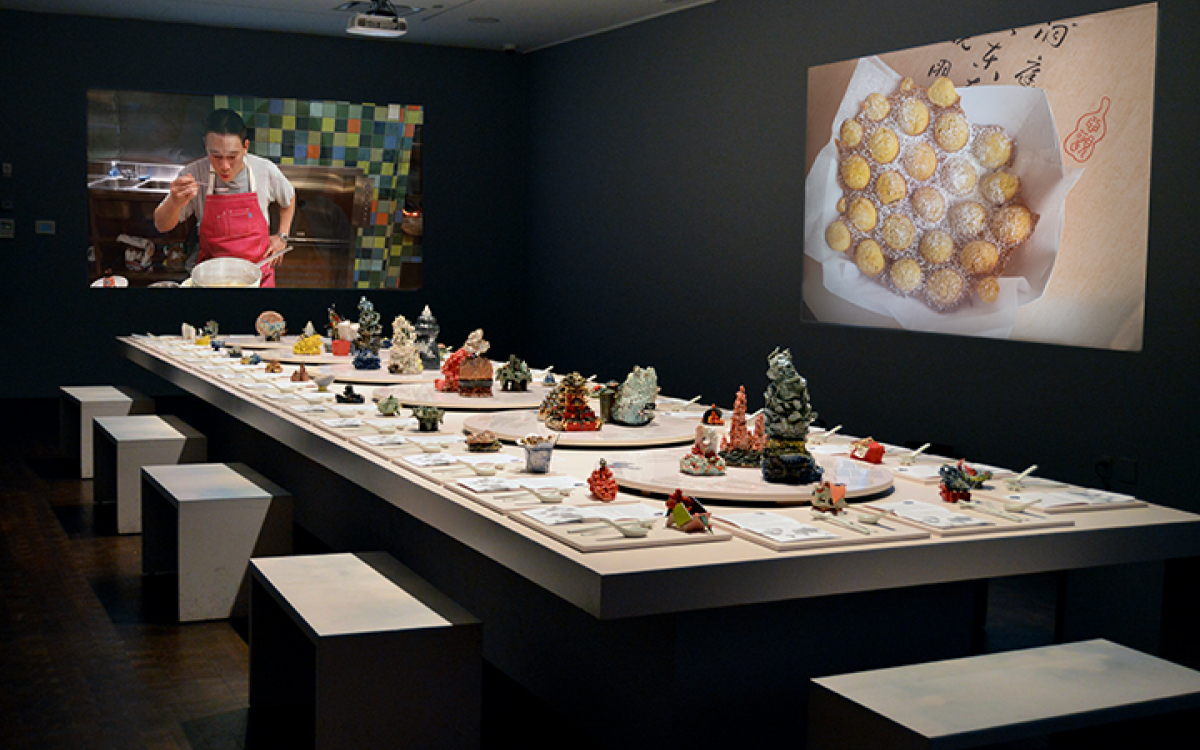
The Museum of Chinese in America exhibit on Chinese food. The big idea is a banquet table decorated with ceramics that represent different regional cuisines.
Focusing Efforts on a Big Idea: When visitors walk into a gallery they should be greeted by a large exhibit element that creates a memorable moment. It must have visual impact, communicate the exhibit’s most important take-away message, and be experiential. If you follow this design approach it will prioritize your design efforts and increase your chances of creating an effective exhibit under a tight budget. Throwing sizable parts of the budget at many different elements produces a weak overall effect. The big idea approach grounds the exhibit experience: the rest of the items in the show are complementary. The big idea approach is about creating a powerful experience for visitors while prioritizing decisions about design and clarifying decisions about budget.
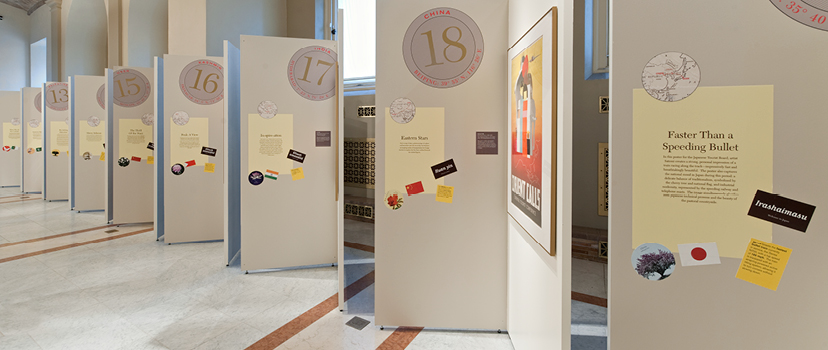
The Museum of Chinese in America exhibit on Chinese food. The big idea is a banquet table decorated with ceramics that represent different regional cuisines.
Reusable Panels Instead of Building Walls. Using reusable panels presents savings in the long-term. Initially they may cost more than building a wall of studs and drywall, but since they may be reconfigured and used again they provide substantial savings if used over multiple exhibits. Products such as Mila-Wall cost around $800 for a 1 x 2.5 meter panel. That is more expensive than drywall, but if you use them more than three times then the investment is worthwhile. The panels make installation a lot easier; they won’t damage floors and may also present savings in labor. Mila-Wall is one of the better options but there are many products. The temporary “look” is part of the product’s nature. Clever layout and painting can help integrate it into the gallery and make it look less like exhibit furniture.
Lighting Design with LED Bulbs: A room’s design can be either exalted or undermined by its lighting design. If you do not have a lighting designer my rule of thumb is to light objects and panels—not the room. The reflected light is often enough to illuminate the room. Only when the room is special—as in a historical building—does it deserve lighting. In those cases the room is part of the exhibit. Thoughtful lighting choreographs the visitor’s attention, provides order to the exhibit and gives ambience to the room. In terms of hardware, we strongly recommend using LED bulbs. They have dropped dramatically in price. They now also offer range of lighting qualities and produce a lot less heat and almost no UV radiation, which is beneficial for the preservation of delicate artifacts.
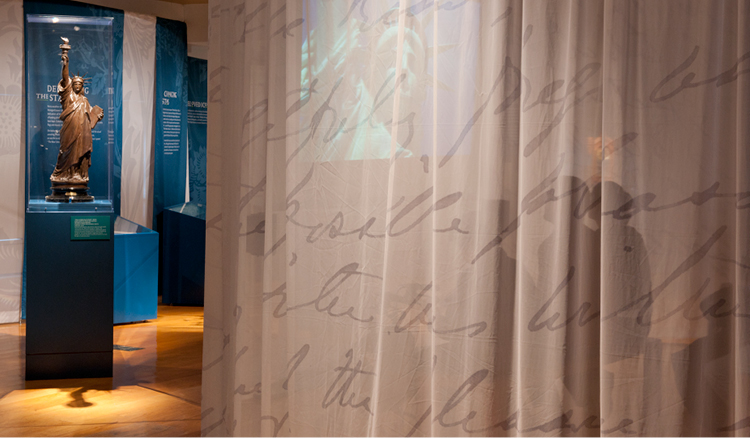
Museum of Jewish Heritage exhibit on the poet Emma Lazarus. Her handwriting was printed on a translucent curtain that encircled a small video theater.
Graphic Fabrics: At around $9 per square foot, custom printed fabrics are a very affordable and attractive way to divide a room. They are also the fastest and easiest way to create visual, spatial and atmospheric effects. Companies that make scrims for theater shows often print and sew graphic curtains for gallery spaces. You can print all types of images yourself, and depending on the fabric you can often print typography at a good resolution. Fabric curtains can also create curved shapes, which would be prohibitively expensive with other materials.
Sustainable Design vs. Cost: It is difficult to be green on a tight budget, but there are some choices that are possible. All major paint brands now have VOC-free paints. They are more expensive than regular paints but have come down in price since first entering the market. With exhibit graphics it is fairly easy to find printing on recyclable materials for a reasonable price—but that does not mean the process to make the material was ecological. It is only sustainable at post-consumption. Check for the FSC or SFI seal (Forest Stewardship Council and Sustainable Forestry Initiative, respectively), to be sure it was produced in a responsible way. For more information on sustainable exhibit tips please visit Sustainable Exhibit Design. (https://museumenvironments.com/sustainabledesign) Another helpful site is Green Printers. They print products such as brochures and postcards and practice high ecological standards.
(https://www.greenerprinter.com/products/standard-business-cards).
Fabricating Cheaper Cases: The least expensive way to fabricate a case is to use a five-sided Plexi cube attached to a wood base or panel. Most millworkers can easily fabricate such a simple case. If your artifacts require more robust environmental protection then a designer is needed to specify the fabrication. Small Corp is a fabricator of good casework at a reasonable price. (They are actually the case fabricator supplying the Display2Go and Gaylord brand of museum supplies. They are not as fancy as the German and Italian case fabricators but they offer quality for a fraction of the price.)
Options in Digital Technology: Hiring a software developer can be very expensive. There are however many new apps on the market that can get specific jobs done. For example if you wish to show audio or video on an iPad kiosk you can use Kiosk Pro (http://www.kioskproapp.com/tour). For creating a timeline there is Capzles and TimeGlider. And if you want to have a scavenger hunt on a mobile device, ActionBound is a great app. There are even many alternatives for building a website, such as WordPress templates, that do not require any programming. To work with these apps and templates there is still a learning-curve, similar to learning a new piece of software. Nevertheless the skill sets of your museum staff will probably suffice. You may need a graphic designer to visually edit the images that are placed in apps and templates in order to make a more handsome product. Our recommendation regarding spending on digital media is to first see if there is an app for your need before considering programming.
LED Projectors and Painted Projection Screen: The price of projectors has dropped substantially. Most importantly, LED projectors are available for under $1000. Because they have a long bulb life they represent the biggest savings. In an exhibit environment, projections are on all day and their bulbs burn out quickly. LED bulbs last longer than any other. The least expensive way to make a projection screen is to paint one on the wall using “Paint on Screen” or similar products. The next is to make a hanging screen with projection screen material. These may be hung like a banner with rods at the top and bottom. Carl’s Place (http://www.carlofet.com/projector-screen-material.html )and Grafix Plastic are two good providers of projection screen material.

A podium and a photo background recreate the taking of the presidential oath. It is the favorite picture moment at the National Constitution Center.
Iconic Selfie Moment: The general idea behind this tip is to create an inexpensive experience for visitors and to help promote the exhibit on social media The exhibit design should provide stages for visitors to take (and share) selfies. The “big idea” mentioned above often plays this role. Any space used this way should be designed to frame an interesting picture for the visitor. It should also be intelligently designed so that it communicates a consistent curatorial message. In addition to the social media marketing benefits, the selfie stage also counts as an experience (especially for young audiences). There is no need to create an expensive immersive environment to be experiential. The selfie is the experience.
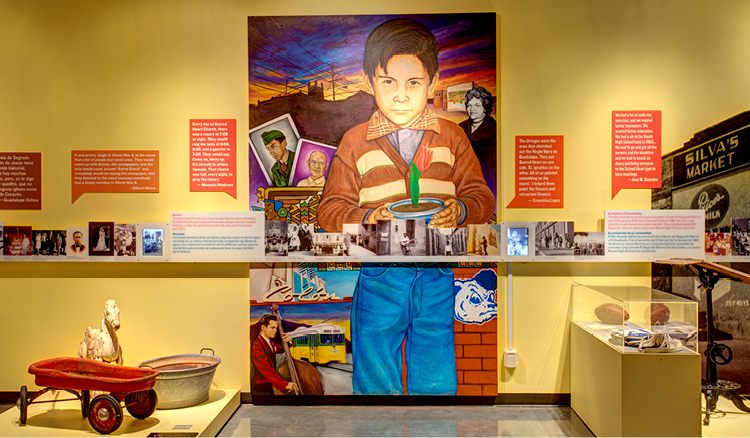
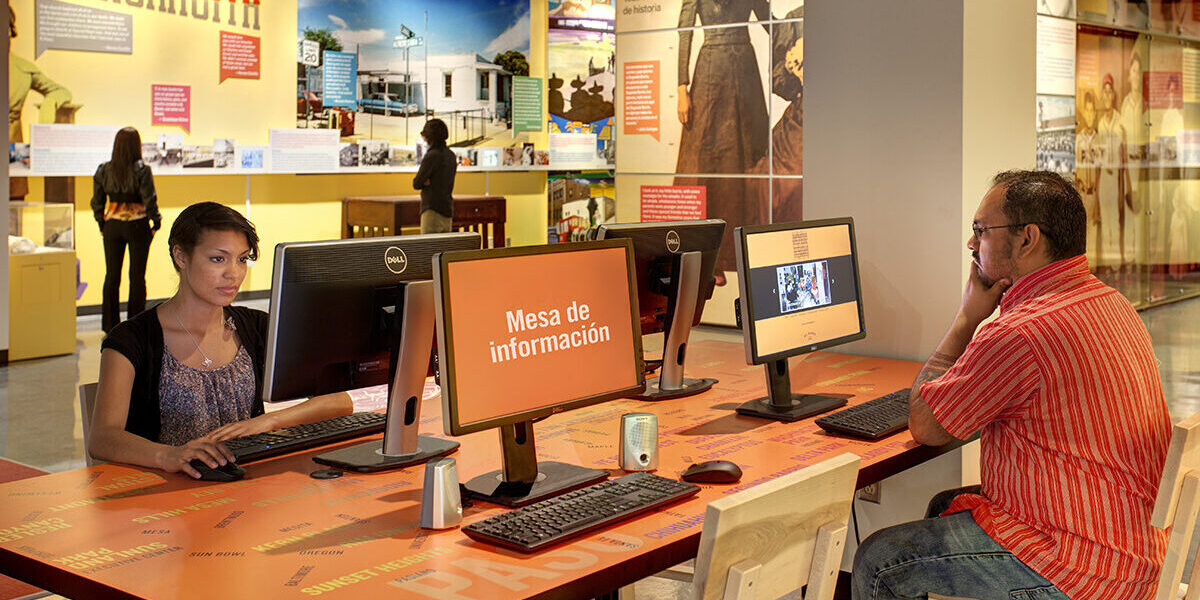
Mural produced by local artist and high school students for an exhibit about the history of El Paso, Texas. The mural had a strong presence in the room.
Use Local Artists and Artisans: If the curator deems it fitting, commissioning local artists and craftsmen can provide results that are visually endearing and potently authentic. They are generally very willing to collaborate with museums because of the exposure it represents. Their work will have a high cultural value for the community the museum serves. But be careful in your choice: their visual statement must work with the rest of the exhibit. If it does, you should see great aesthetic impact for the investment. An artist mural will be more powerful and get more attention from the press and social media than the typical photomurals one sees in exhibits.
This list is a perennial work in progress and we will update it periodically. New ideas on making exhibits more affordably arise every day. New technologies get less expensive, allowing us to do things we would not consider before. So please follow us and we will keep you updated. Also feel free to share tips and we will credit you as a contributor.
Copyright © 2026 · All Rights Reserved · Museum Environments
· Log in